Sit down, dear. Somebody has to say it plainly, and it might as well be a grandmother.
The question we get most is also the simplest: is salt an electrolyte? Yes. Next question.
Fine, I'll give you the long version too. It's the one we keep coming back to, so these are the lessons I've picked up so far, in the order I wish someone had told me.
Lesson 1: salt is two electrolytes holding hands
Table salt is sodium chloride. Drop it in water and it comes apart into sodium and chloride, and both of those carry an electric charge. That's what makes something an electrolyte. So when somebody asks whether salt is an electrolyte, the honest answer is that salt is where two of the main ones come from.
The other two you'll meet on most labels are potassium and magnesium. If you want the full cast list, our plain guide to electrolytes has it.
Lesson 2: you probably get plenty of salt already
This one surprises people. According to the Swedish Food Agency (Livsmedelsverket), adults should keep salt to about 6 grams a day, and the average adult in Sweden eats more than that. Bread, cheese, cold cuts and ready meals do most of the work, long before anyone opens a can of anything.
So on an ordinary day with ordinary meals, nobody needs to go hunting for extra sodium. I'd rather tell you that than pretend otherwise.
Lesson 3: sweat is not just water
Sweat contains sodium and smaller amounts of other minerals. That's the reason people think about electrolytes when things get sweaty: a long session in a warm gym, a sauna, a hot summer day, a packed commute in July. It's not magic and it's not a medical event. It's just salt leaving through the skin, and some people simply like a salty drink afterwards.
Lesson 4: read the label, not the slogan
Every drink that mentions electrolytes sounds the same from across the room. Up close, three things matter:
- How much of each mineral is in a serving, not just that it's "in there".
- How much sugar comes along for the ride.
- Whether there's caffeine, and how much.
If a label won't tell you those three things, it's a slogan, not a label. I've read a lot of slogans. Most of them need to sit down.
Lesson 5: ready to drink is about laziness, and that's fine
Powders and tablets are cheap per serving and easy to pack. They also need a bottle, water and a spare minute. A can is the lazy option in the best possible way: open it, drink it, carry on with your day. That's the whole pitch. I'm not going to dress it up.
Where Saltcore fits, in numbers
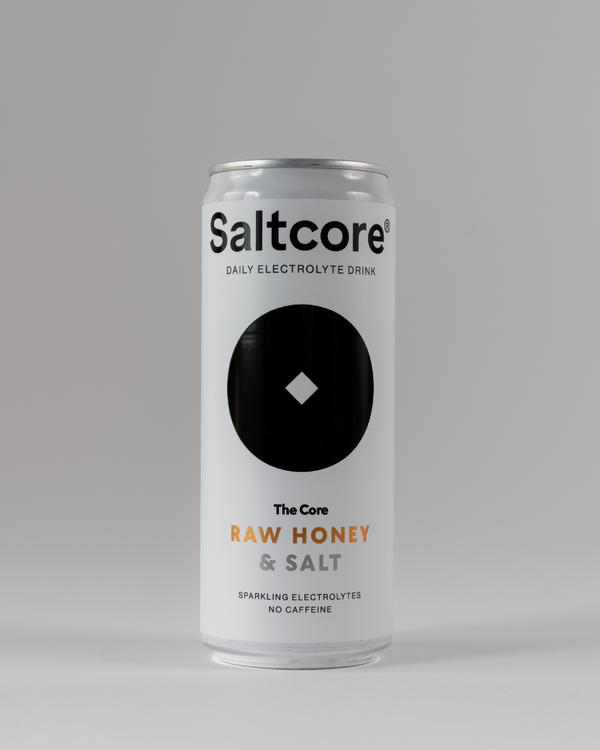
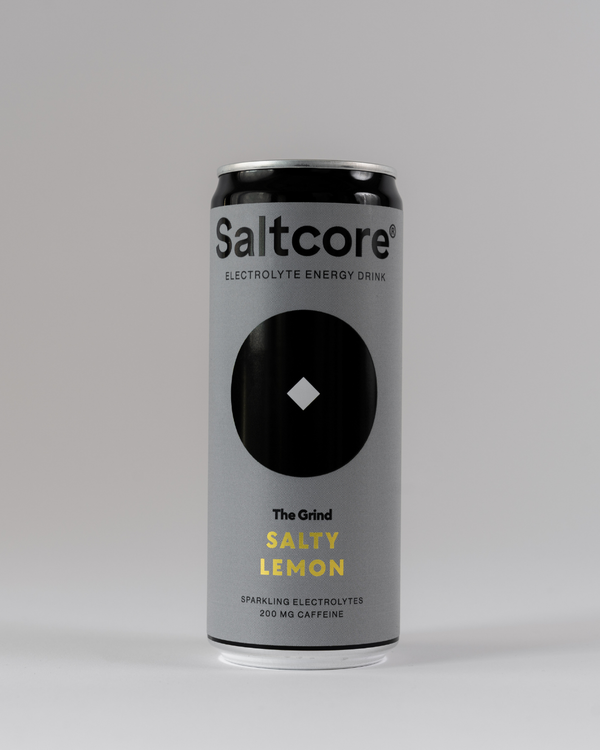
Saltcore® is an everyday electrolyte drink. Carbonated, ready to drink, made in Sweden, and every can has 500 mg of electrolytes.
The Core (Raw Honey & Salt) is caffeine-free, with 7 kcal and 0.2 g of salt per can. It's a source of magnesium, which contributes to the reduction of tiredness and fatigue, and of potassium, which contributes to normal muscle function.
If you want caffeine with your salt, there's The Grind (Salty Lemon): 200 mg of caffeine, 10 kcal and 0.34 g of salt per can. High caffeine content. Not recommended for children or pregnant or breast-feeding women (61 mg/100 ml). / Hög koffeinhalt. Rekommenderas inte för barn eller gravida eller ammande kvinnor (61 mg/100 ml).
Put those salt numbers next to the 6 grams from Lesson 2 and you'll see why nobody should be afraid of a can. It's a small part of a day, not a big one.
The short version, for the fridge door
- Salt is an electrolyte, or rather two of them: sodium and chloride.
- Most of us already get plenty of salt from food.
- Sweat contains sodium, which is why electrolytes come up around training, heat and sauna.
- Read the label: minerals, sugar, caffeine.
- A can is convenient. It is not a miracle, and it is not a health trend.
That's what I know so far. I'll let you know if I learn anything else. Granny always does.
Life is salt.